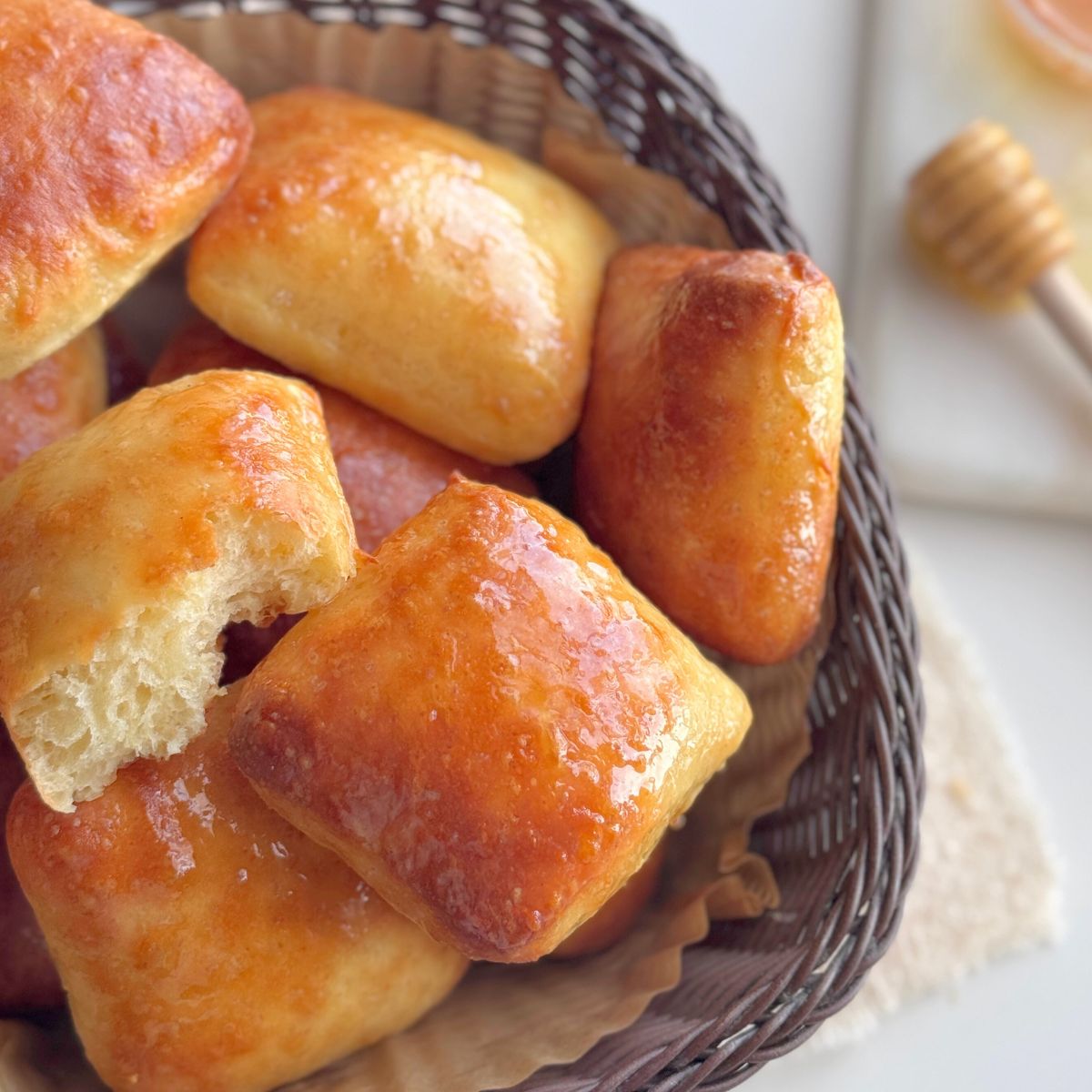
Quick No-Knead Honey Butter Dinner Rolls
servings20 rolls
Soft, fluffy honey butter dinner rolls made with a quick no-knead dough, inspired by classic steakhouse rolls.
Watch how to make the recipe
Ingredients
Dough
- 3 cups (360 g) all-purpose flour (plain flour)
- 2¼ teaspoons (7 g) instant yeast (see note 1 if using active dry yeast)
- 1 teaspoon (6 g) salt
- 2 Tablespoons (25 g) white granulated sugar
- 1 cup (240 ml) warm milk (see note 2)
- 3 Tablespoons (45 g) butter, melted (salted or unsalted)
- 1 large egg, at room temperature
Honey Butter
- 3 Tablespoons (45 g) butter, melted
- 1 Tablespoon (20 g) honey
Instructions
- Flour mixture: In a large bowl, stir together the flour, yeast, salt, and sugar.
- Milk mixture: In another bowl or measuring jug, whisk together the warm milk, melted butter, and egg.
- Pour the milk mixture into the flour mixture.
- Stir with a spatula or dough whisk until a soft dough forms. The dough will look very soft and sticky, this is normal.
- First rise: Cover the bowl and let the dough rise for 50–60 minutes, until doubled in size.
- Sprinkle about ¼ cup flour on your counter. Turn the dough out onto the floured surface and lightly dust the top so it doesn’t stick while rolling.
- Roll the dough into a rectangle about 10 × 12 inches (24 × 30 cm).
- From the short side, make 3 cuts to create 4 strips, each about 2½ inches (6 cm) wide.
- Make 4 cuts in the opposite direction, about 2½ inches (6 cm) apart, to create 20 squares.
- Place the squares on a lined baking tray, leaving about 1 inch (2.5 cm) space between them.
- Second rise: Cover loosely and let the rolls rise for 20–25 minutes.
- Adjust the oven rack to the middle position and preheat the oven to 350°F (175°C). If using a fan oven, set it to 320°F (160°C).
- Bake for 15–20 minutes, until lightly golden. Rotate the tray halfway through baking. If the tops begin browning too quickly, loosely cover with foil.
- Stir together the melted butter and honey to make the honey butter. Brush over the rolls while they are still hot from the oven.
Recipe Notes
1. Yeast: If using active dry yeast instead of instant yeast, stir it into the warm milk from the recipe with a pinch of the sugar. Let it sit for 5–10 minutes until foamy, then add the melted butter and egg and continue with the recipe.
2. Milk and butter temperature: The milk should be warm, not hot — about 105–110°F (40–43°C). If you don’t have a thermometer, it should feel comfortably warm to the touch, not hot. If it feels hot, let it cool slightly before using. If the butter was just melted, let it cool for a minute or two so it’s warm, not hot, before adding it to the milk mixture.
Nutrition
Serving: 1serving | Calories: 121kcal | Carbohydrates: 18g | Protein: 3g | Fat: 4g | Saturated Fat: 2g | Polyunsaturated Fat: 0.3g | Monounsaturated Fat: 1g | Trans Fat: 0.1g | Cholesterol: 19mg | Sodium: 152mg | Potassium: 56mg | Fiber: 1g | Sugar: 3g | Calcium: 21mg | Iron: 1mg